Pond Advice: Common Pond Problems and Solutions
Green pond water, blanket weed, duckweed, a pond losing water, fish gasping at the surface. Here's what causes each problem and what you can do about it. If you'd rather have it fixed properly, WhatsApp me, Gary at Pond Cleaning Kent. I clean and repair ponds across Kent, London, Surrey and East Sussex. Need kit? See the pond products I recommend.
Tap a question to see the answer.
Water problems
Why is my pond water green, and how do I clear it?
Quick answer: Green pond water is millions of tiny floating algae, fed by sunlight and nutrients. The correct size UV clarifier with the right size filter clears it and keeps your water clear. Create shade on the pond (water lilies are great for this) and don't overfeed your fish.
Why it happens
- Strong sunlight on open water
- Nutrients from fish waste, uneaten food and rotting leaves
- A filter that's too small, or no UV clarifier
- New ponds often go green a few weeks after filling, while the filter and plants settle in
What to do
- Fit the correct size UV clarifier for the volume of water in your pond, and run it with the filter day and night
- Make sure you have the correct pond pump, so the flow rate through the filter and UV is adequate
- Shade the surface. Lilies and floating plants over about half the pond work well
- Don't overfeed. Only give what your fish eat in a few minutes
- Clear the sludge and leaves off the bottom
- Give it time. With a working UV the water usually starts to clear within a week or two
- For a quicker result you can add a green water treatment, but it's only a short-term fix. It only works long term with a properly working UV clarifier
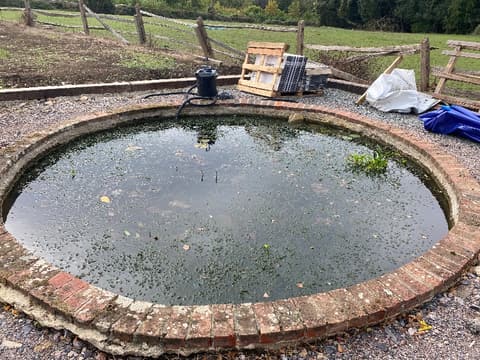
Watch out: Don't empty the pond and refill it. Tap water is full of nutrients, so the green comes straight back.
What to buy: UV clarifier and green water treatment.
Pond still green? Gary at Pond Cleaning Kent can clear it.
I'll clean out the sludge, check your filter, pump and UV are the right size for your pond, and get the water clear again.
Why is my pond water cloudy or brown?
Quick answer: Cloudy pond water is fine particles or bacteria floating in the water. Brown or murky water usually means soil or rotting leaves, and milky white water usually means a bacteria bloom. If your pond smells of rotten eggs or sewage too, there's sludge rotting on the bottom.
Why it happens
- Brown or muddy water comes from soil washed in after heavy rain, or koi stirring up the bottom
- Tea-coloured water is a stain from rotting leaves
- Milky white water is a bacteria bloom from overfeeding, something rotting, or a new pond settling in
- A pond that smells of rotten eggs or sewage has thick sludge on the bottom that's run out of oxygen
- A filter that is inadequate for the size of the pond
- A pond pump that is too small for the filter and pond
What to do
- Net out leaves and anything rotting
- Make sure you're not overfeeding your fish
- Clean your filter sponges and media frequently, depending on the time of year (see how often to clean your pond, filter and pump)
- Stop soil washing in from beds and lawns around the edge
- If you have a thick layer of sludge on the bottom of your pond, WhatsApp me, Gary at Pond Cleaning Kent, for a full or partial clean
Watch out: If the water keeps going cloudy or the pond smells, there's usually a thick layer of sludge on the bottom that needs to come out. Leave it and it can suddenly starve your fish of oxygen.
What to buy: filter bacteria (filter start).
Cloudy or smelly pond? Gary at Pond Cleaning Kent can sort it.
I'll vacuum out the sludge and rotting leaves, clean your filter and get your water clear again.
Why is my pond losing water, and how do I find the leak?
Quick answer: Losing a few centimetres a week in hot weather is normal evaporation. Any more than that and it's usually a splashing waterfall, a leaking pipe or filter, or a hole in the pond liner.
Common causes
- Evaporation in hot, sunny or windy weather
- A waterfall or fountain splashing water out
- Leaking pipework, hose joints or filter box
- A tear or hole in the pond liner, or a low spot in the edge
- Plants at the edge drawing water out over the side
How to find the leak
- Top up to a marked level, then turn off the pump and waterfall
- While the pump is off, make sure you have an adequate air stone running, so oxygen levels don't drop too low
- If the level stops dropping, the leak is in the pump, pipes, filter or waterfall
- If it keeps dropping and then stops at one height, the leak in the liner is around that height
- Check the edges for wet ground or a dip in the liner
Watch out: Don't keep topping up a leaking pond with untreated tap water. It harms the fish and feeds algae.
Pond leaking? Gary at Pond Cleaning Kent can fix it.
I'll find the leak and fix it by replacing pipes or patching a damaged liner, or, if it's beyond repair, replace the liner with a new one.
Weeds and algae
How do I get rid of blanket weed in a pond?
Quick answer: Pull out as much blanket weed as you can, then starve it with fewer nutrients, more plants and more shade. It thrives in sunny, nutrient-rich water in spring and summer.
Why it happens
- Sunlight on clear, shallow water
- Nutrients from fish waste, food and sludge
- Topping up with hard tap water
- Too few plants competing with it
What to do
- Twist it out with a stick, rake or blanket weed brush
- Leave it on the side for a day so any creatures can crawl back in, then compost it
- Feed less and get the sludge out to cut the nutrients
- Add plants that use up nutrients and shade the water
- If you use a blanket weed treatment, follow the label exactly, take out the dead weed and add extra air
Watch out: Dying weed uses up oxygen, so keep a close eye on your fish after any treatment.
What to buy: blanket weed treatment and brush.
Blanket weed taking over? Gary at Pond Cleaning Kent can clear it.
I'll pull out the weed and clean out the sludge that feeds it, without harming your fish or wildlife.
How do I get rid of duckweed in a pond?
Quick answer: Net it off regularly and get every last bit out. Duckweed doubles fast, and any you leave behind grows back.
Why it happens
- It arrives on birds' feet and on new plants
- Still water with lots of nutrients
- It can cover a whole pond in a few weeks in summer
What to do
- Skim it off with a fine net every few days until it's gone
- Once you've removed as much as you can, add a duckweed treatment. Follow the label exactly and add extra air, as dying weed uses up oxygen
- Use a pond skimmer if you have a pump
- Rinse new plants before they go in
- Cut the nutrients by feeding less and getting the sludge out
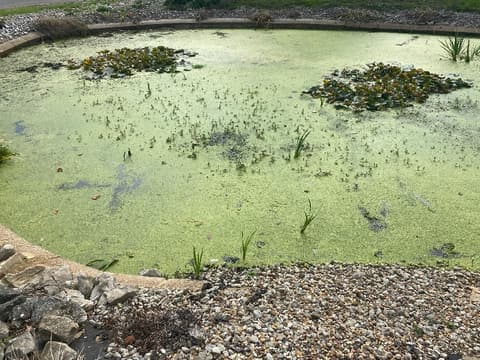
Watch out: Once it covers the whole pond, a full clear-out is usually the quickest fix.
What to buy: fine pond net for duckweed.
Pond covered in duckweed? Gary at Pond Cleaning Kent can clear it.
I'll get every last bit out, like I did on this pond in Rainham, and get the water healthy again.
Does barley straw work in ponds?
Quick answer: Barley straw does work, but as prevention. It helps stop algae coming back, but it won't clear pond water that's already green.
How it works
- As it slowly rots in well-oxygenated water, it releases substances that hold algae back
- It takes 4 to 8 weeks to start working
- It works best put in early, before the algae takes off
How to use it
- Put it in in early spring, loose in a net bag near moving water
- Use roughly 50g per square metre of surface
- Replace it after about six months
- Liquid barley straw extract works faster
Watch out: Barley straw doesn't replace a good filter, a UV clarifier and plants. Use it alongside them.
What to buy: barley straw.
Still fighting algae? Gary at Pond Cleaning Kent can get on top of it.
I'll clean out the sludge that feeds it and check your filter and UV are up to the job, so the water stays clear.
Fish
Why are my pond fish gasping for air at the surface? Urgent
Immediate action needed: act now
Fish can suffocate and die very quickly. Get air into the water straight away. Turn on the waterfall or fountain, or put in an air pump with an air stone.
Quick answer: Pond fish gasping at the surface usually means there isn't enough oxygen in the water. Add air immediately, then do a small water change.
Why it happens
- Hot weather, because warm water holds less oxygen
- Night-time, when plants and algae use up oxygen too
- Heavy, thundery weather
- The pump or air pump has stopped
- Poor water quality (ammonia or nitrite), or weed rotting after a treatment
What to do now
- Add air immediately. Turn on the waterfall or fountain, or add an air pump with an air stone
- Change about 10 to 20% of the water, using dechlorinated water
- Stop feeding for a day
- Test the water for ammonia and nitrite
- Take out any dead fish or rotting plants
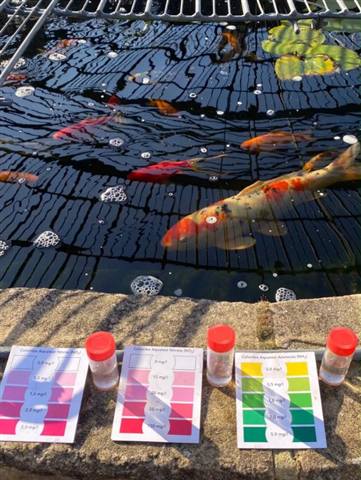
Watch out: Oxygen is at its lowest just before dawn, so don't leave gasping fish overnight without extra air.
What to buy: pond water test kit and pond air pump.
Fish still struggling? Gary at Pond Cleaning Kent can sort the water out.
I'll test the water, clean out the sludge and filter, and make sure your pond has enough air, so it doesn't happen again.
How often should I feed my pond fish?
Quick answer: How often you feed your pond fish depends on the water temperature. In the south of England that means 2 to 4 small feeds a day in summer, about once a day in spring and autumn, a little wheatgerm food every few days when the water is below 10°C, and nothing below 5°C. Only feed what they eat in about 5 minutes.
Why it matters
- Fish are cold-blooded, so they slow right down in cold water and can't digest much
- Food they don't eat rots on the bottom and fouls the water
- Overfeeding is one of the main causes of green and cloudy water
Golden rules
- Only feed what they eat in about 5 minutes
- Net out any food left floating
- Measure the water with a pond thermometer, not the air
- Go by the water temperature, not the date
Feeding through the year in the south of England
| Season | Typical water temperature | How often | What to feed |
|---|---|---|---|
| Winter Dec to Feb | 4°C to 8°C | Below 5°C, don't feed. On mild spells (5°C to 8°C), a pinch once or twice a week, only if the fish come up for it | Wheatgerm (easy to digest) |
| Spring Mar to May | 8°C to 15°C | Every 2 to 3 days at 8°C to 10°C, then once a day from 10°C to 15°C | Wheatgerm, moving to a staple food above about 12°C |
| Summer Jun to Aug | 15°C to 25°C | 2 to 4 small feeds a day. Feed less above 25°C, as warm water holds less oxygen | Staple or growth food |
| Autumn Sep to Nov | 15°C falling to 5°C | Once a day, then every 2 to 3 days below 10°C. Stop below 5°C | Back to wheatgerm below about 12°C |
Typical for a garden pond in Kent, London, Surrey and Sussex. A mild winter or a cold spring shifts these, so go by your thermometer, not the calendar.
What to buy: pond thermometer and pond fish food.
Want your fish pond looked after? Gary at Pond Cleaning Kent can do it all year.
My maintenance visits keep the water clean, the filter working and your fish healthy, whatever the season.
Cleaning and equipment
How often should I clean my pond, filter and pump?
Quick answer: Clean your pond regularly to prevent problems, not to cure them. Regular filter cleans and vacuuming stop cloudy water, bad smells, blanket weed, low oxygen and sludge from building up in the first place.
Regular cleaning prevents
- Cloudy water
- A bad smell
- Blanket weed
- Poor oxygen levels
- Sludge building up on the bottom
Don't wait for problems
- Cleaning works best as a preventative measure, done before these problems start
- Once they've taken hold, a pond often needs a full or partial clean to get it right
- Most garden ponds also need a full clean every one to three years, best in autumn or spring
Cleaning through the year
| Season | Filter clean | Vacuum the bottom and sides |
|---|---|---|
| Spring Mar to May | Every 2 to 3 weeks as the fish get active | A thorough vacuum of the bottom and sides as the water warms up |
| Summer Jun to Aug | Every 1 to 2 weeks (weekly for busy koi ponds) | A light vacuum once a month |
| Autumn Sep to Nov | Every 2 to 3 weeks, and clear leaves off the pump | Vacuum once the leaves have fallen, before winter |
| Winter Dec to Feb | Once a month, or whenever the flow drops | Leave it alone while the fish are resting |
Typical for a garden pond in the south of England. Clean the filter sooner if the flow slows down.
Why the filter matters
- The sponges hold the good bacteria that break down fish waste
- The chlorine in tap water kills those bacteria
- A blocked filter or pump means weak flow and murky water
How to clean a pond filter and pump
- Rinse the sponges in a bucket of pond water, never tap water
- Clean only half the sponges at a time
- Clear leaves from the pump's intake
- Change the UV bulb every 6 to 9 months
- Check pipes and hoses for blockages
Cleaning a pond with fish in it? You don't always have to take the fish out. For a regular clean I vacuum with the fish left in. For a full clean I move them into aerated tanks of their own pond water, then refill with treated water and let them settle back in slowly.
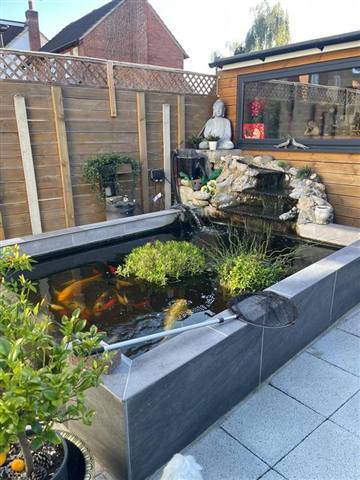
Read my full guide to when to clean a pond.
What to buy: pond vacuum and pond pump and filter.
Rather it was all done for you? Gary at Pond Cleaning Kent offers maintenance packages.
Monthly, quarterly, or spring and autumn visits. I clean the filter and pump and vacuum the pond, with your fish left in, so problems don't get the chance to start.
How do I calculate pond volume in litres?
Quick answer: To calculate pond volume in litres, multiply the length by the width by the average depth in metres, then multiply by 1,000. For a round pond, use 3.14 × radius × radius × average depth × 1,000. For an irregular shaped pond, use the average length and width, then take off about 15%.
Why you need to know
- Pumps, filters and UV clarifiers are all sized by the litres in your pond
- Treatments and tap water conditioner are dosed by litres too
- Too small a pump or filter is one of the main reasons ponds go green
How to measure
- Measure in metres, at the water line
- Measure the depth in several places, including the shelves, and use the average
- For an irregular pond, measure the length and width in two or three places and use the averages
- To change litres to gallons, divide by 4.55
Working it out
| Shape | How to work it out | Example |
|---|---|---|
| Square or rectangle | Length × width × average depth × 1,000 | 3m × 2m × 0.8m deep × 1,000 = 4,800 litres |
| Circle | 3.14 × radius × radius × average depth × 1,000. The radius is half the width across | 2.5m across, 0.6m deep: 3.14 × 1.25 × 1.25 × 0.6 × 1,000 = about 2,940 litres |
| Irregular shape | Average length × average width × average depth × 1,000, then take off about 15% | 4m × 2.5m × 0.7m deep × 1,000 = 7,000, less 15% = about 5,950 litres |
All measurements in metres. 1 cubic metre holds 1,000 litres.
Pond volume calculator
Enter your measurements to see your pond volume.
Watch out: When dosing treatments, round your volume down. When buying a pump, filter or UV clarifier, round it up.
What to buy: UV clarifier and pond pump and filter.
Not sure your pump, filter and UV are big enough? Gary at Pond Cleaning Kent can check.
I'll work out your pond volume and make sure your pump, filter and UV clarifier are the right size, so the water stays clear.
What size UV clarifier do I need for my pond?
Quick answer: It depends on your pond volume and how much sun it gets. A fish pond needs about 1.5 watts of UV for every 1,000 litres in shade, 2 watts in part sun and 3 watts in full sun. Koi ponds need double. So a 5,000 litre goldfish pond in part sun needs an 11 watt UV clarifier, and a 10,000 litre pond needs 15 to 30 watts depending on sun. The same sizes apply whether it's sold as a UV clarifier, UV filter, UV light or UV steriliser. Change the UV bulb every 6 to 9 months.
What affects the size
- How many litres are in your pond (see how to calculate pond volume)
- Sun, because a pond in full sun grows about twice as much algae as one in shade
- Koi, which need about twice the UV of goldfish
- Pump flow, because the water has to pass through slowly enough for the UV to work
Getting it right
- Work out your pond volume first
- Decide if your pond is in shade, part sun or full sun for most of the day
- Pick a UV from the table below, and if your size isn't made, go up to the next one
- Make sure your pump flow is below the UV's maximum flow rating
- Run the UV day and night, all year round
- Change the UV bulb every 6 to 9 months, and clean the quartz sleeve when you do
Fish pond: UV clarifier size by pond size and sun
| Pond size | Shade | Part sun | Full sun |
|---|---|---|---|
| 1,000 litres | 5 watt | 5 watt | 5 watt |
| 2,500 litres | 5 watt | 5 watt | 9 watt |
| 5,000 litres | 9 watt | 11 watt | 15 watt |
| 10,000 litres | 15 watt | 20 watt | 30 watt |
| 15,000 litres | 24 watt | 30 watt | 45 watt |
| 20,000 litres | 30 watt | 40 watt | 60 watt |
| 30,000 litres | 45 watt | 60 watt | 90 watt |
Minimum UV for a goldfish or fish pond. Shade means sun for less than about 4 hours a day, full sun more than about 6 hours. Your pump should move the whole pond through the filter and UV every 2 hours.
Koi pond: UV clarifier size by pond size and sun
| Pond size | Shade | Part sun | Full sun |
|---|---|---|---|
| 1,000 litres | 5 watt | 5 watt | 7 watt |
| 2,500 litres | 9 watt | 11 watt | 15 watt |
| 5,000 litres | 15 watt | 20 watt | 30 watt |
| 10,000 litres | 30 watt | 40 watt | 60 watt |
| 15,000 litres | 45 watt | 60 watt | 90 watt |
| 20,000 litres | 60 watt | 80 watt | 120 watt |
| 30,000 litres | 90 watt | 120 watt | 180 watt |
Koi need about twice the UV of goldfish. Your pump should move the whole pond through the filter and UV every hour. On big koi ponds, two UV clarifiers side by side is normal.
Watch out: A UV bulb still lights up after 6 to 9 months, but it stops working on the algae. If your water is green and the bulb is old, change the bulb first.
What to buy: UV clarifier and pond pump and filter.
Not sure your UV is up to the job? Gary at Pond Cleaning Kent can check it.
I'll check your pond volume, pump and UV, change the bulb and clean the quartz sleeve, so your water stays clear.
What size pond filter do I need?
Quick answer: Buy a pond filter rated for more than your pond volume. Filter ratings are usually for lightly stocked ponds in shade, so for a goldfish pond choose one rated for at least 1.5 times your pond volume, and for koi at least twice. Pair it with a pump that moves the whole pond through the filter every 2 hours (every hour for koi).
What affects the size
- Your pond volume in litres (see how to calculate pond volume)
- How many fish you have. Koi make a lot more waste than goldfish
- Sun, because a pond in full sun needs more filtering
- Your pump flow, which has to be within the filter's maximum flow
Getting it right
- Work out your pond volume first
- Choose a filter from the table below, and if in doubt, go bigger
- Pick a pump with the right flow for your pond, and no more than the filter's maximum flow
- Allow for the height of any waterfall, as it cuts the pump's flow
- A filter with a built-in UV saves fitting a separate one, as long as the UV is the right size for your pond (see what size UV you need)
Pond filter size by pond size
| Pond size | Pump flow (litres an hour) | Filter rating for a fish pond | Filter rating for a koi pond |
|---|---|---|---|
| 1,000 litres | 500 to 1,000 | 1,500 litres | 2,000 litres |
| 2,500 litres | 1,250 to 2,500 | 4,000 litres | 5,000 litres |
| 5,000 litres | 2,500 to 5,000 | 7,500 litres | 10,000 litres |
| 10,000 litres | 5,000 to 10,000 | 15,000 litres | 20,000 litres |
| 15,000 litres | 7,500 to 15,000 | 22,500 litres | 30,000 litres |
| 20,000 litres | 10,000 to 20,000 | 30,000 litres | 40,000 litres |
| 30,000 litres | 15,000 to 30,000 | 45,000 litres | 60,000 litres |
Filter makers rate their filters for lightly stocked ponds in shade, so these figures allow for real garden ponds with fish and sun.
Watch out: A filter that's too small is one of the main reasons ponds go green and cloudy. Going one size bigger costs little and saves a lot of trouble.
What to buy: pond pump and filter and UV clarifier.
Not sure your filter is big enough? Gary at Pond Cleaning Kent can check it.
I'll check your pond volume, pump and filter, and service the filter so it's working at its best.
Can I top up my pond with tap water?
Quick answer: Yes, you can top up your pond with tap water, but always treat it first with a pond water conditioner (dechlorinator).
Why it needs treating
- Tap water contains chlorine or chloramine, which harm fish
- It kills the good bacteria in your filter
- It adds nutrients that feed algae and blanket weed
What to do
- Add dechlorinator every time you top up, dosed for the amount you're adding
- Top up little and often rather than doing big refills
- Rainwater from a water butt is good for topping up wildlife ponds
What to buy: tap water conditioner (dechlorinator).
Pond needs a proper clean and refill? Gary at Pond Cleaning Kent can do it.
After every clean I refill with treated water, so it's safe for your fish from day one.
Autumn and winter
Should I put a net over my pond?
Quick answer: Yes. Net your pond from early autumn until the leaves have finished falling. It's the easiest way to stop sludge building up.
Why it helps
- Leaves that sink rot down into sludge
- Rotting leaves feed algae and give off gases over winter
- A net also keeps herons away from your fish
What to do
- Fit it before the leaves start to fall, usually in September or October
- Keep it tight and above the water, so frogs and birds can't get tangled
- Clear the leaves off it every week or two
- Take it off once the trees are bare, or leave it on all year if herons are a problem
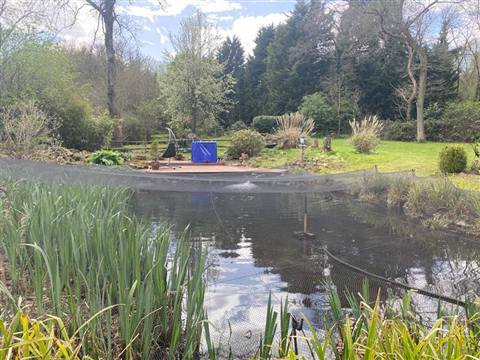
What to buy: leaf net for autumn.
Want your pond netted? Gary at Pond Cleaning Kent can fit it.
I fit leaf netting and do autumn clean-outs, like this 25,000 litre pond in Sevenoaks.
Should I turn my pond pump off in winter?
Quick answer: No. Keep your pump, filter, UV, waterfalls and fountains running all year round, at the same flow rate.
Why it matters
- The good bacteria in the filter die if it's off for weeks
- Moving water keeps the oxygen up and helps stop the surface freezing over
- Ice can trap harmful gases under the surface
What to do
- Keep the pump and filter running all winter, at the same flow rate as the rest of the year
- Keep waterfalls and fountains running throughout the year
- Leave the UV on all year round
- Raise the pump off the bottom so it doesn't stir up the warmer deep water
- Keep a small hole in the ice with a floating pond heater or ice preventer
Watch out: Never smash the ice on a pond. The shock waves can harm or kill your fish.
What to buy: floating pond heater or ice preventer.
Want your pond ready for winter? Gary at Pond Cleaning Kent can get it sorted.
I'll clean the filter and pump, check your UV and get the leaves and sludge out before the cold sets in.
Rather I Sorted It?
I clean, maintain and fix ponds across Kent, London, Surrey and East Sussex. Send me a few photos and your postcode for a free, no-obligation quote.